Dev Journal
Missing the Mark
Not All Games Start Out as Winners
Sep 10, 2025
I enjoy wordplay: homonyms, puns, double entedres, things like that. One morning while looking for 3D printing for the Farrago dice, I saw some small bridge segments that were 3D printed. The following train of thought occurred:
- I wonder if there are multiple types of bridge pieces available?
- People could try to build a bridge. They'd compete to see who could build theirs first.
- A bridge that's rushed will have bad structural integrity, so even though it could be finished first, it might fall down.
- Companies that cut corners will have bridges with less integrity.
- Companies that cut corners and do shady business deals have less integrity.
- I should make a game about companies competing to build bridges that fastest, and cutting corners to do so. I could call it Integrity and play on the double meaning.
... And so it began. The primary idea would be that a company would risk their bridge collapsing in order to finish building their bridge first. They'd make choices that would lower their business integrity, but would allow them to build segments of their bridge faster. But the more integrity they - and in turn their bridge segments - lost, the most likely their segments would be to collapse when an event occurred, like a wind storm, earthquake, tidal wave, or giant monster.
I was really jazzed about this idea. First, it had a story: the Mayor of New MegaCity wanted to hire a construction company to build their new city hall and all other city contracts. Rather than do a normal bid, Ms. Mayor challenged the biggest construction companies to compete for the contract: the first company to build a bridge across the fast flowing MegaRiver would be awarded the contract.
Next, it was tactile: players could see their progress. It was tactical: they could choose to just gather resources and slowly construct their bridges, or combine resources to strengthen their bridges against sabotage and collapse. Or they could cut corners and make shady deals to build their segments faster.
Events would have several challenge ratings. Dice rolling would determine if you beat them. The lower your company's integrity score, the fewer dice you could roll to beat the event challenge ratings. The lower your overall roll, the worse the effects of the event (more damaged or collapsed bridge segments).
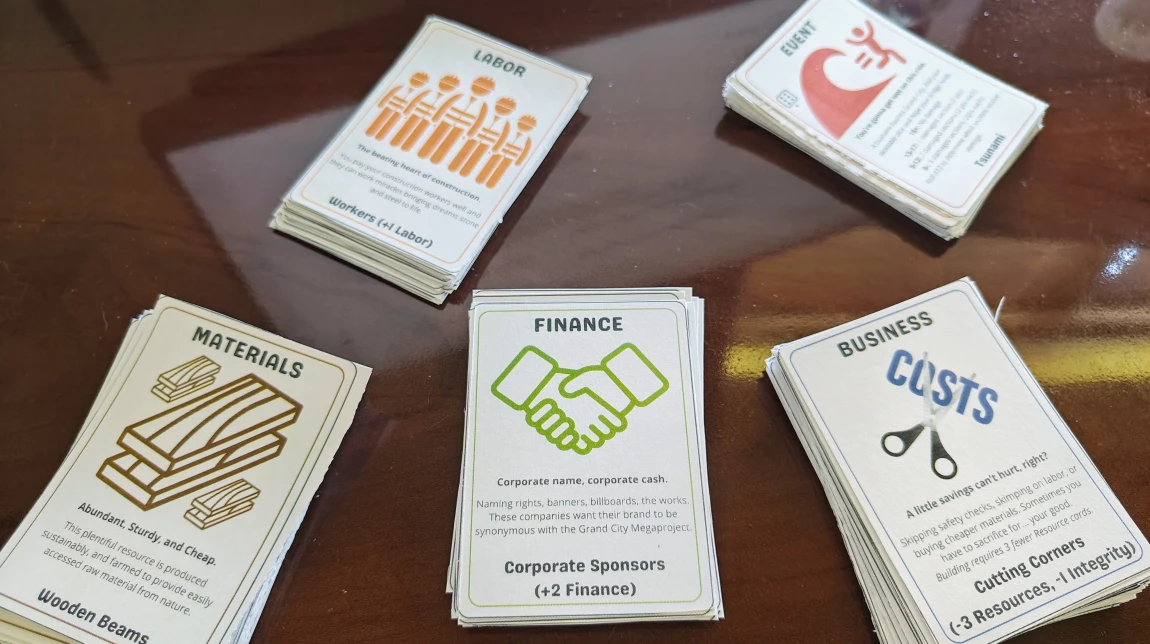
All this was coming together quickly. I came up with the resources you'd gain that you could spend to build bridge components (similar to Catan's resources for building towns and roads). There were Labor, Material, and Finance cards that were all used to build bridge segments. Then there were Business cards that allowed you to cut corners (build with fewer Resource cards), perform espionage, steal goods, sabotage, run smear campaigns, etc. And lastly, there were the Event cards.
I designed all the cards, wrote all the rules for their use, balanced the resource materials and actions. I then started printing and cutting. Being one of my earlier designs, I did a LOT of cutting, because I hadn't yet gotten a paper cutter, and there were a ton of cards. Finally, I designed a basic board and used pawns as placeholders for the bridge pieces. I was so hyped about this game that I'd gone from game concept to playable prototype in a matter of days! Then... I played.
So... here's the thing with game design: sometimes the idea just doesn't jive with the mechanics. The mechanics don't work with the goals. The goals don't work with the theme, and so on. In this instance, I had built a game that yes, allowed players to build a bridge. They would acquire materials, build sections of bridge, and eventually win. But the big thing they were supposed to do - risk their integrity to build faster - well... there was no reason to do that. You could either rely on the cards to just work out better for you to build sooner, or wait for there to be a card that would boost your build. Either way, there was no real impetus to lower your integrity; to risk your bridge collapsing. The biggest concept behind the game was not actually in the game.
That's not to say it won't work... eventually. It's just funny how we can sometimes be so focused on all the pieces and minutiae of the game that we actually forget about the gameplay itself. I spent a ton of time designing the cards, thinking about the bridge pieces, the board itself. My idea had run up against the wall of reality - of actually playing the game - only to find that the two didn't vibe. So... back to the drawing board I'll go. I still like this concept, and I'll eventually figure out how to get people to want to be devious and underhanded to win. But I'll need to make it a requirement of the game such that you are almost guaranteed to lose if you play everything straight.
Was I disappointed? Yeah, for sure. It's great when some things just work. But was I surprised? Not really. More often than not, the first playthrough of a game goes a long way into showing you what won't work a lot more than it shows you what will. It's all part of the process.