Absolute: Having Nothing Means Everything




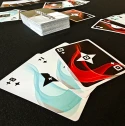

- Simple Math Meets Deep Strategy
- Swap cards from your hand with a played set to get cards you need or lower another player's points
- Regroup your sets for more points
- Zero Cards are wildcards with special rules
- 2-6 Players, Ages 10+, Play time: 30-60 minutes
- Contains 88 cards (positive and negative numbers 0-11, with four suits - squares, circles, diamonds, and stars), and instruction booklet
Absolute is a card game for 2-6 players where you play sets of 3 or more cards that add up to zero, and the largest absolute number card is the base points for that set. Your goal is to make the highest scoring sets each round. You gain additional points for extra cards, positive and negative runs, matching suits, and four of a kind. Each round players get a chance to build or improve their own sets for more points and mess with those of other players to reduce their points. The player with the most points after 3 rounds wins!
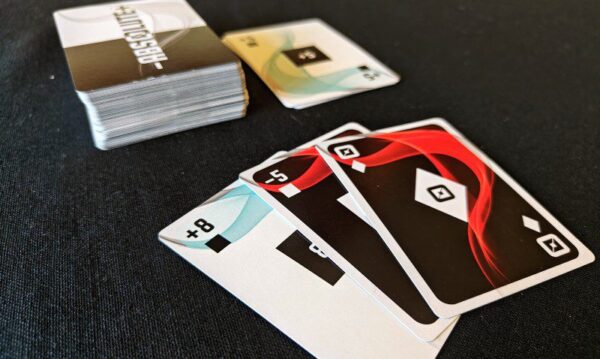
Example of a set worth 8 points. Zeroes are wildcards!
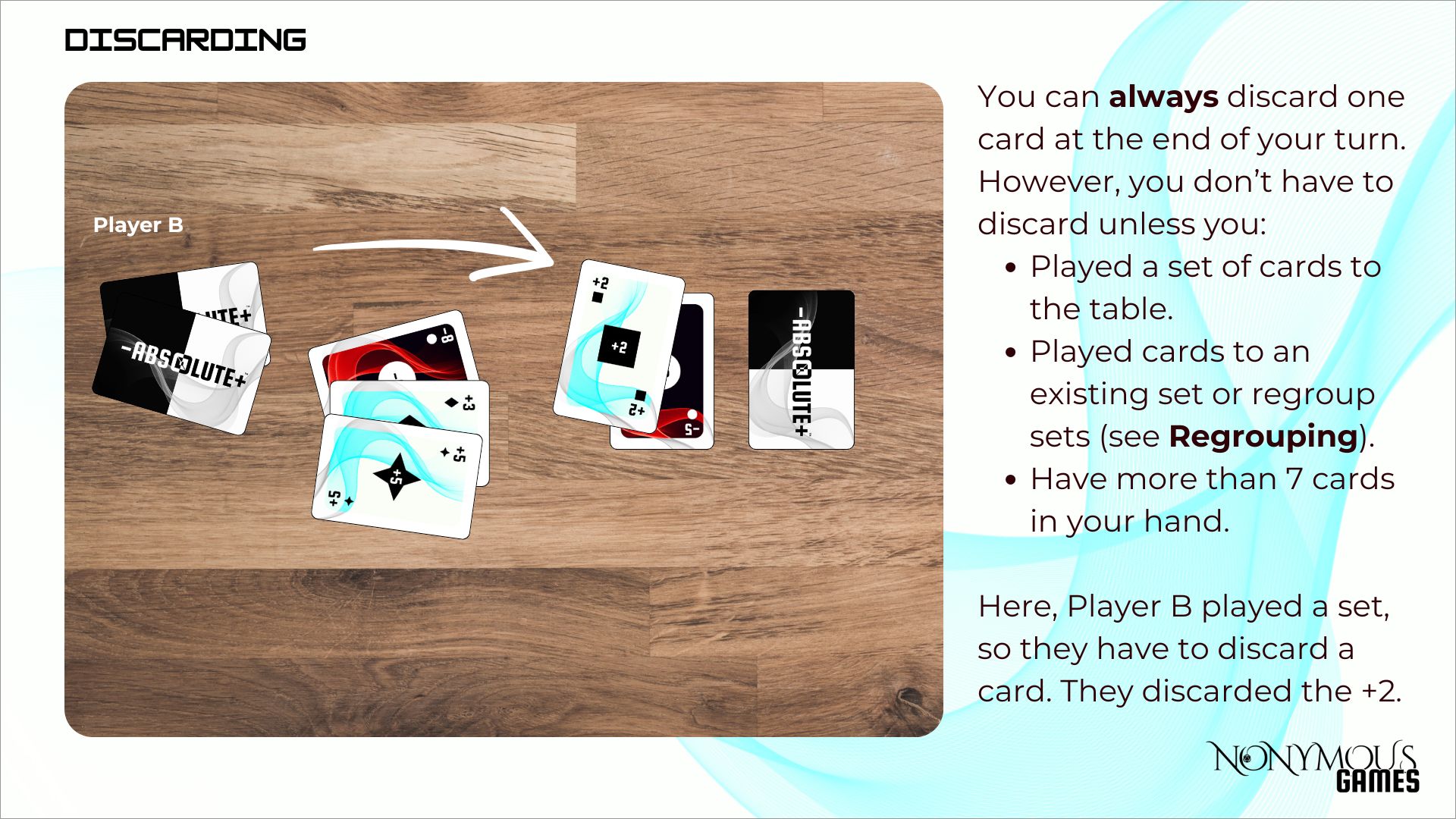
On your turn you draw a card from the deck or discard pile. You may swap up to 2 cards from your hand with up to 2 cards from any one played set from any player. Then you can play sets, add cards to existing sets, or play cards to regroup your sets into new sets (for more points). If you play any cards, then you have to discard a card.
Zero cards are wild with their own set of rules and limitations that make their use strategic rather than just replacing a card.
The player with the highest score after 3 rounds wins!
Leave a review at our page on Board Game Geek!
Alternate Gameplay Rules (v1.0)
Printable Instructions w/Examples (English)
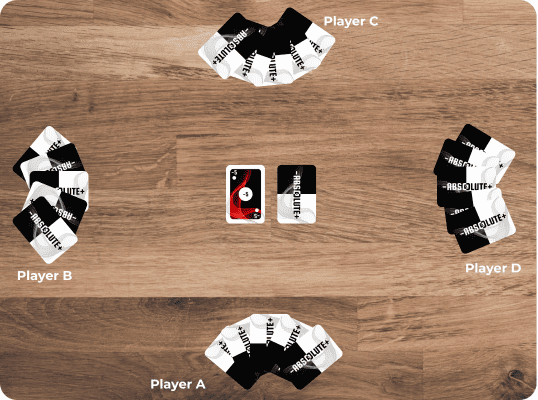
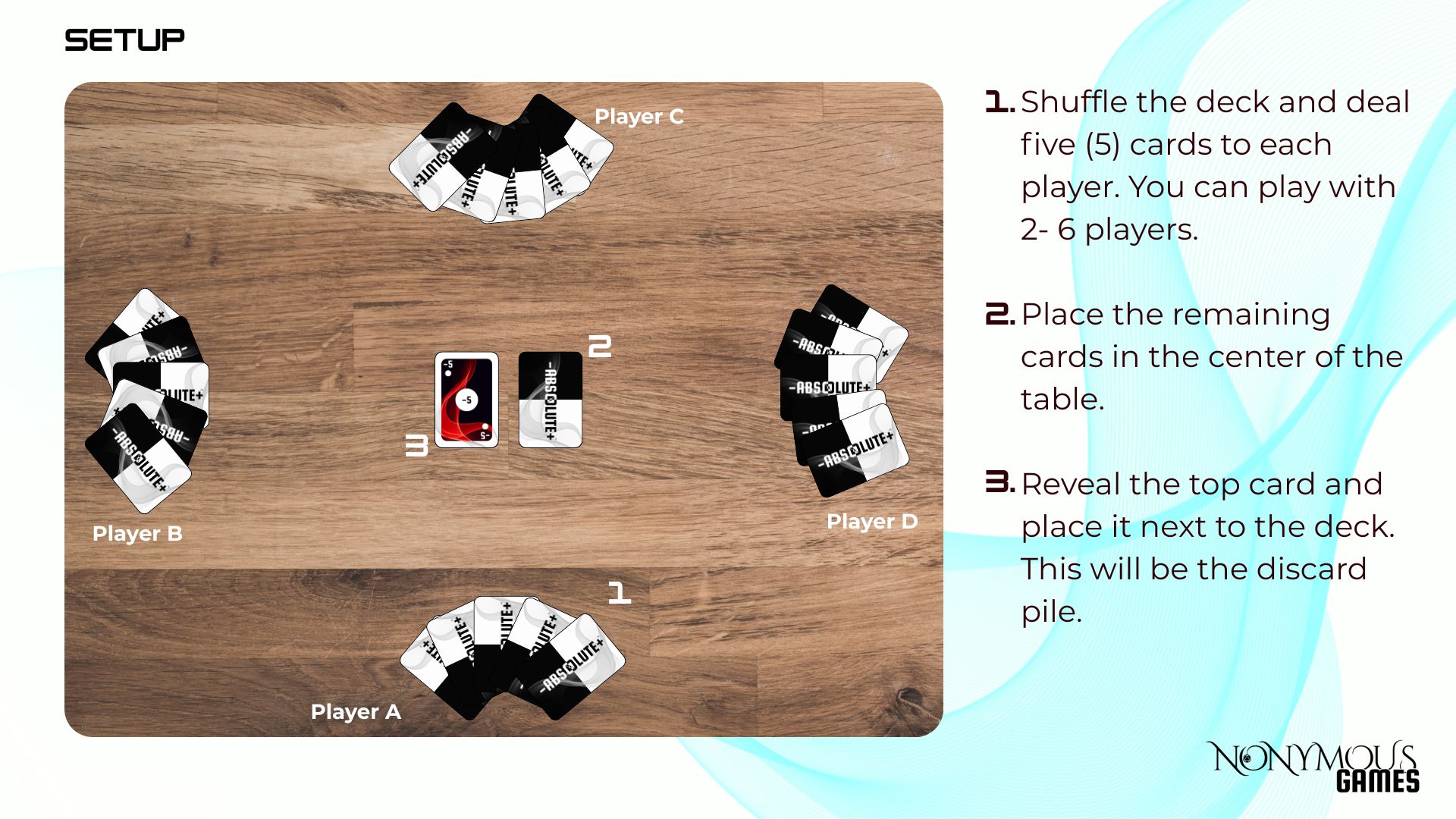
4-player Setup for Absolute
- Draw a card from the deck or discard pile.
- [Optional] Swap up to 2 cards from your hand with up to 2 cards in any one played set, including those of other players.
- [Optional] Play cards to the table by:
- Playing sets of 3 or more cards whose sum equals zero
- Adding cards to already played sets
- Playing cards to regroup current sets into better sets
- Discard a card if required, or say "Hold" if you haven't played a card and don't need or want to discard (if you play cards or if you have more than 7 cards, you have to discard).
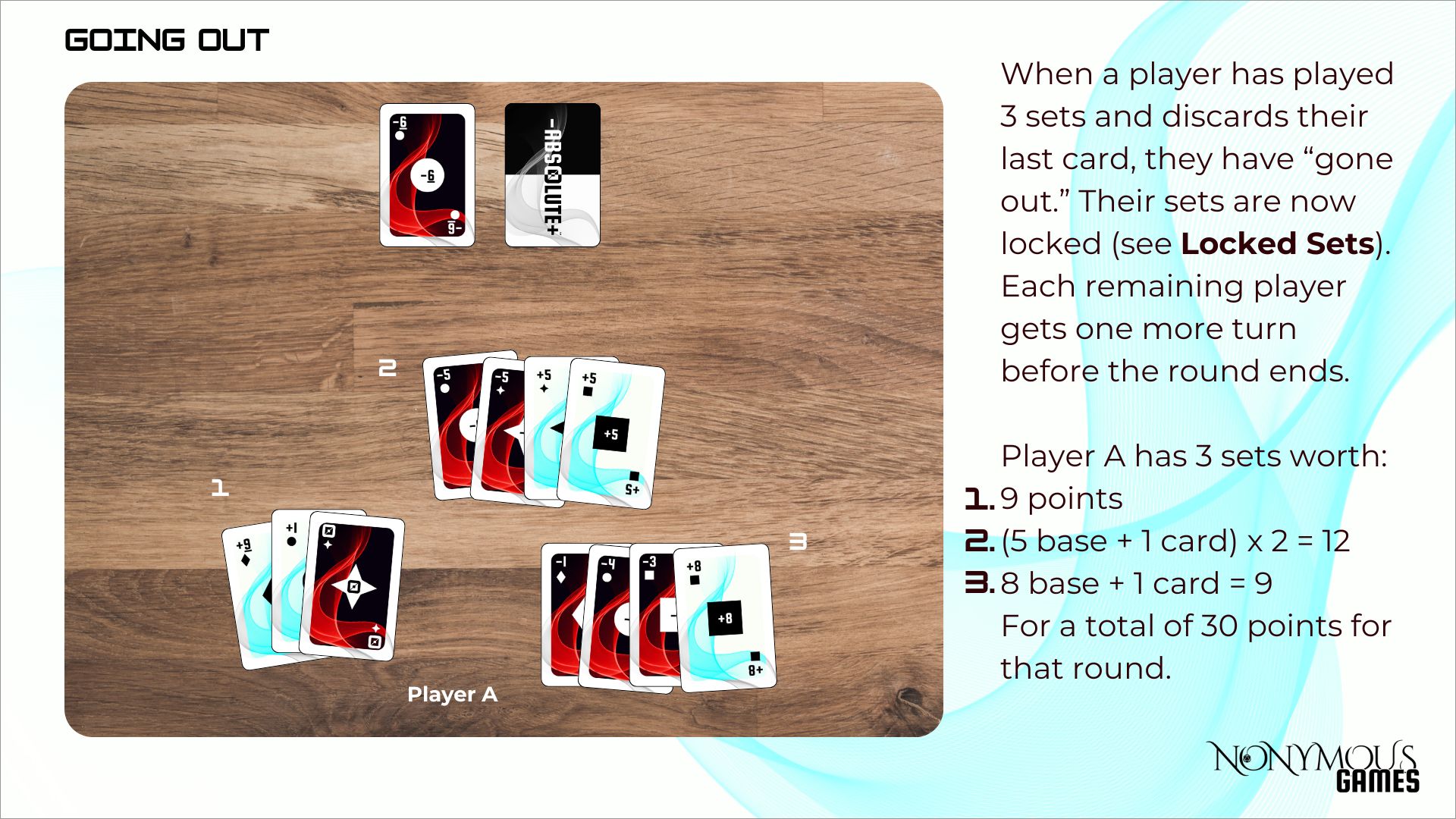
Play moves clockwise to the next player. If a player has played at least 3 sets and discarded their last card, they've "gone out." Each remaining player gets another turn as a chance to go out. Once play returns to the first player to go out, the round is scored. Any player with cards in their hands will lose points from their total. The player who has the most points after three rounds wins!
Zero Cards
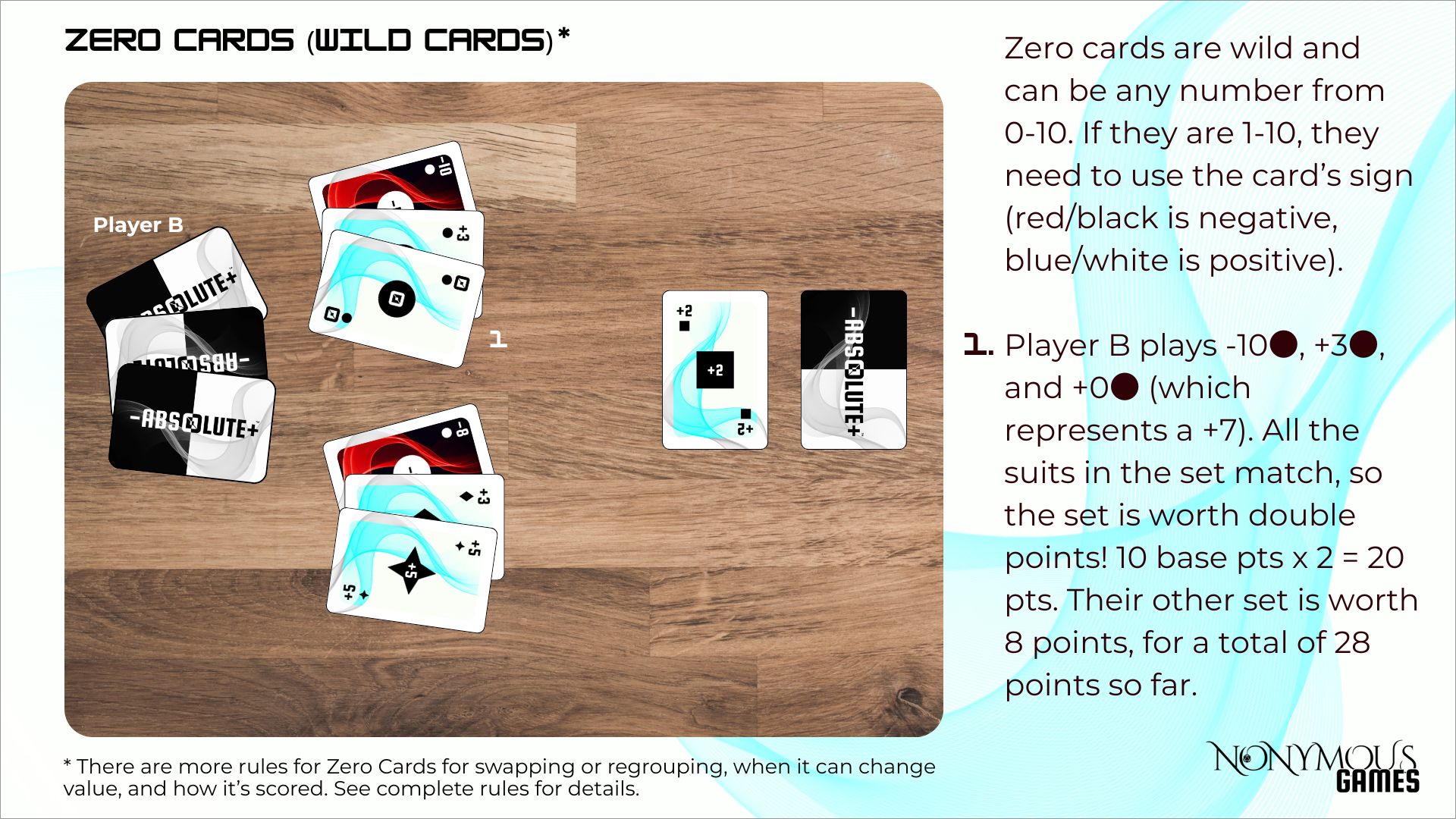
Zero cards act like wildcards and are able to represent any number from 0-10. If they're representing a number other than zero, they have to use the card's sign: red/black cards are negative, while blue/white cards are positive.
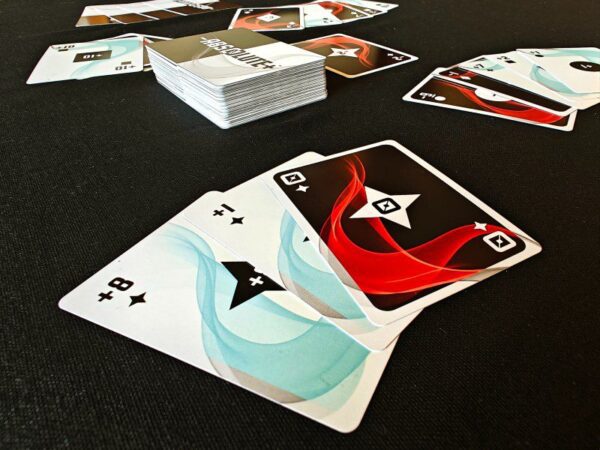
In this set, the zero card represents a -9.
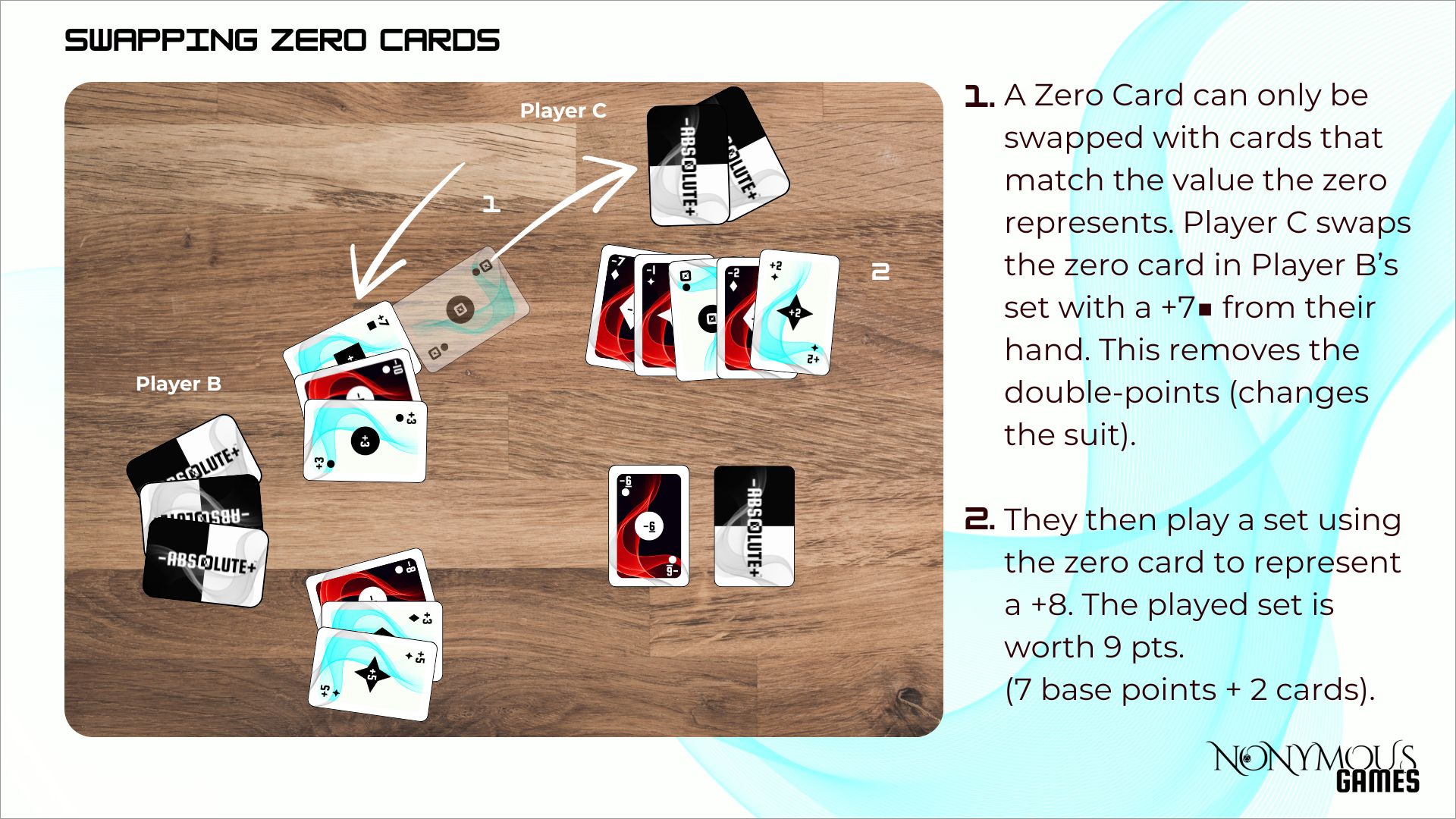
Only one zero card is allowed per set, and it can only be swapped out for the number it represents: if it represents a +6, you could swap in a +2 and +4, or a +6, and so on (see Swapping). While zero cards can change their value when moved to a new set (see Regrouping), they can't change their represented number when altering an existing set:
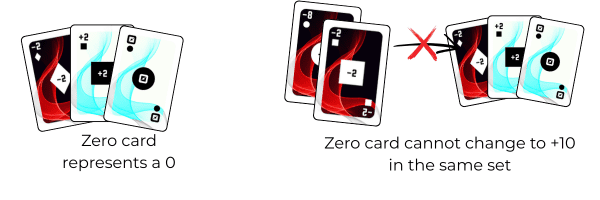
The currently played set (left) has the zero card representing a 0. The player has -8 and -2 cards in their hand, but they can't add them to the existing set because doing so would change the represented value of the zero card to +10.
Swapping
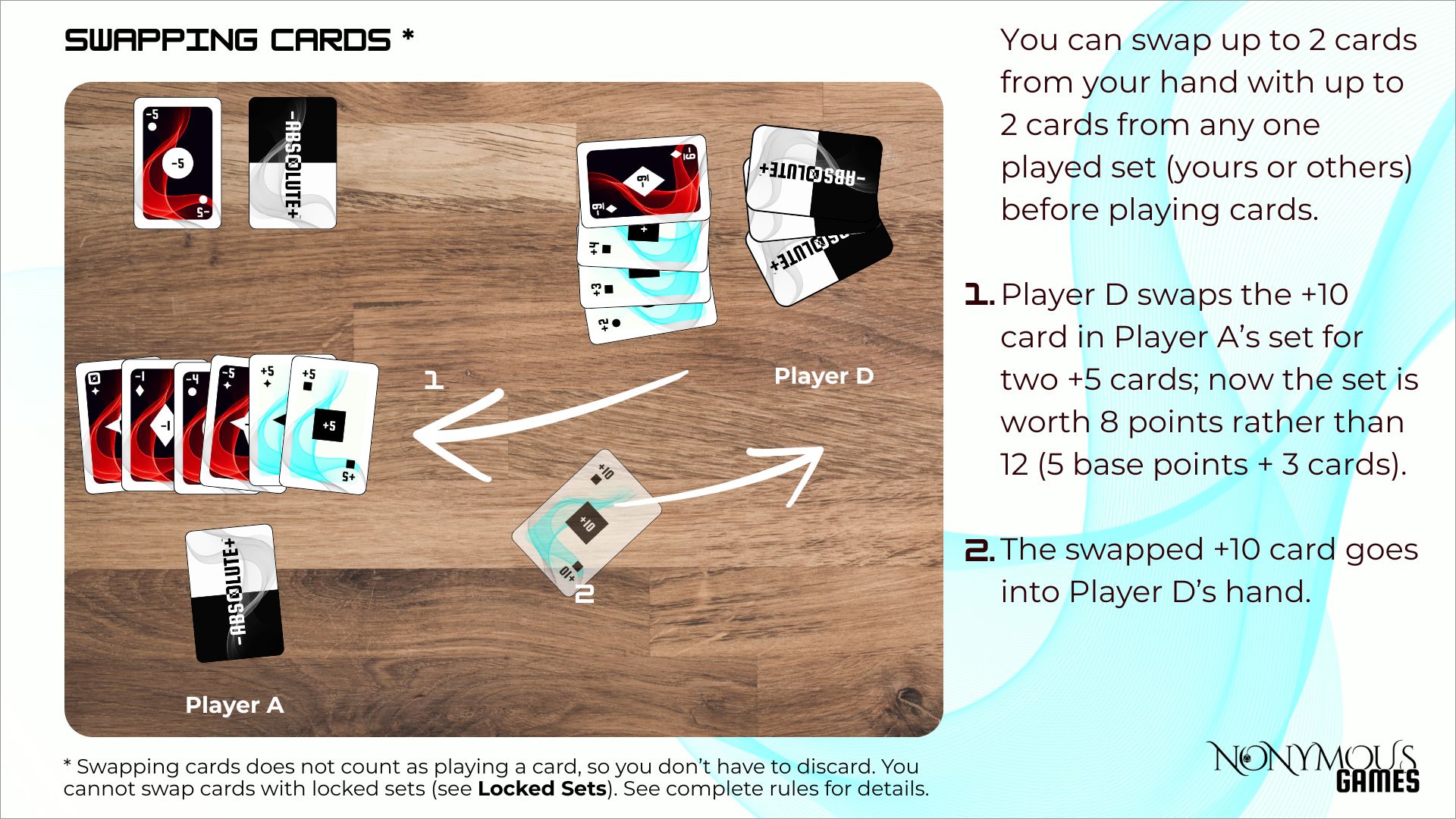
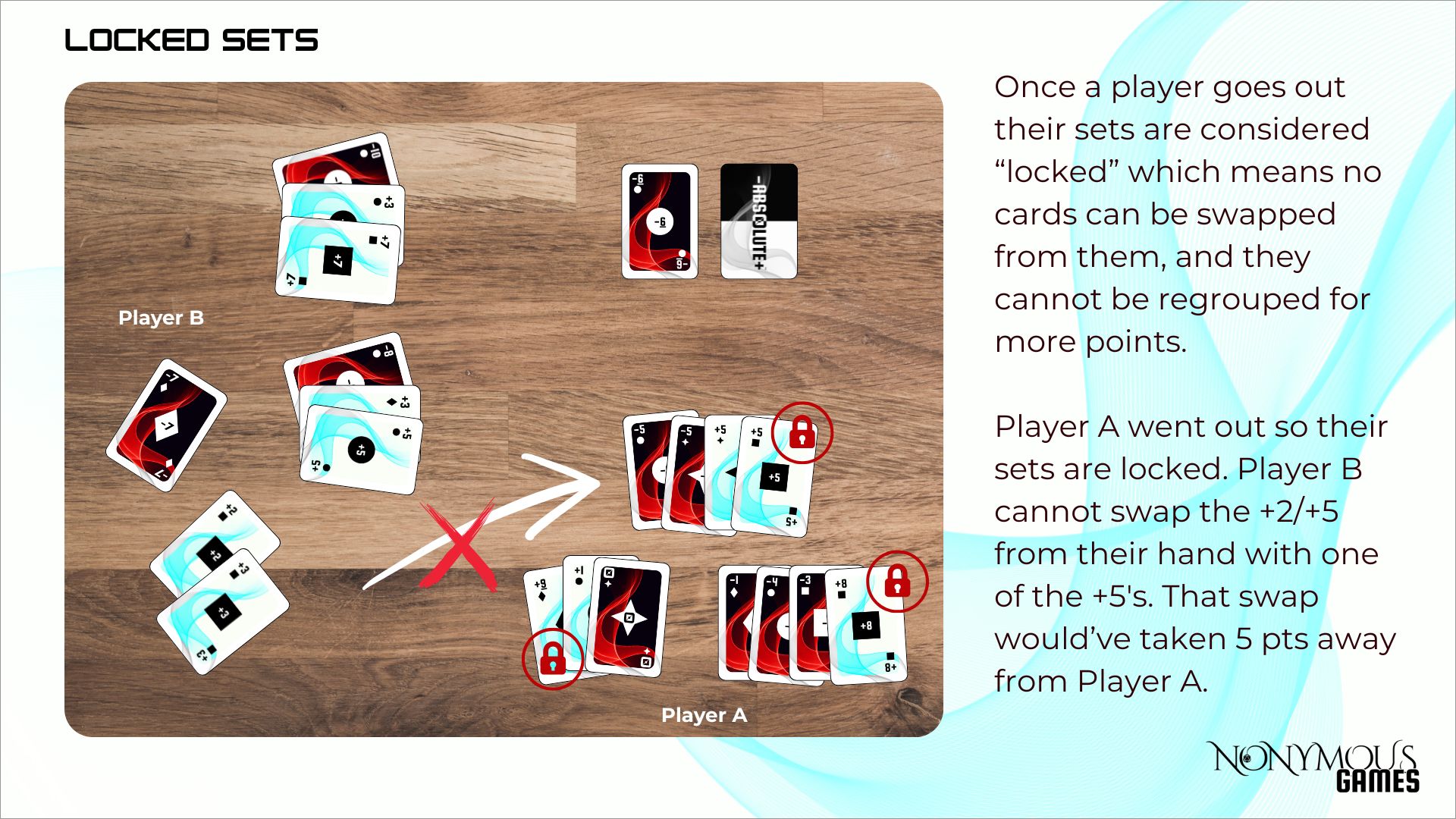
After you draw a card and before playing any cards, you can swap up to 2 cards from your hand with up to 2 cards from any one set on the table. This can get you the cards you need, hurt a player's points, or both. The swapped cards go into your hand.
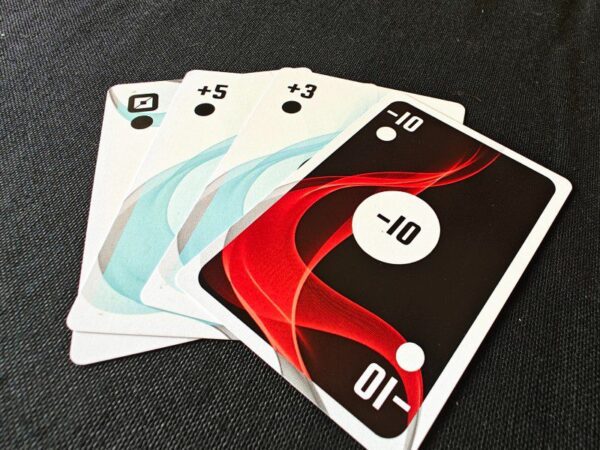
Player A plays this set, where the zero card is a +2. This set is worth 22 points (see Scoring)
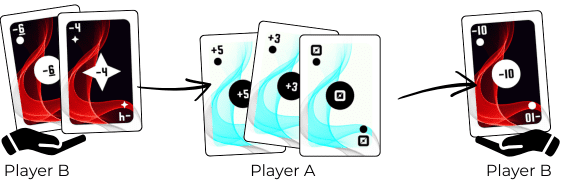
Player B swaps the -10 with -6 circle and -4 star cards, placing the -10 card in their hand, and dropping that set down to just 8 points (see Scoring); a massive hit to Player A!
Regrouping
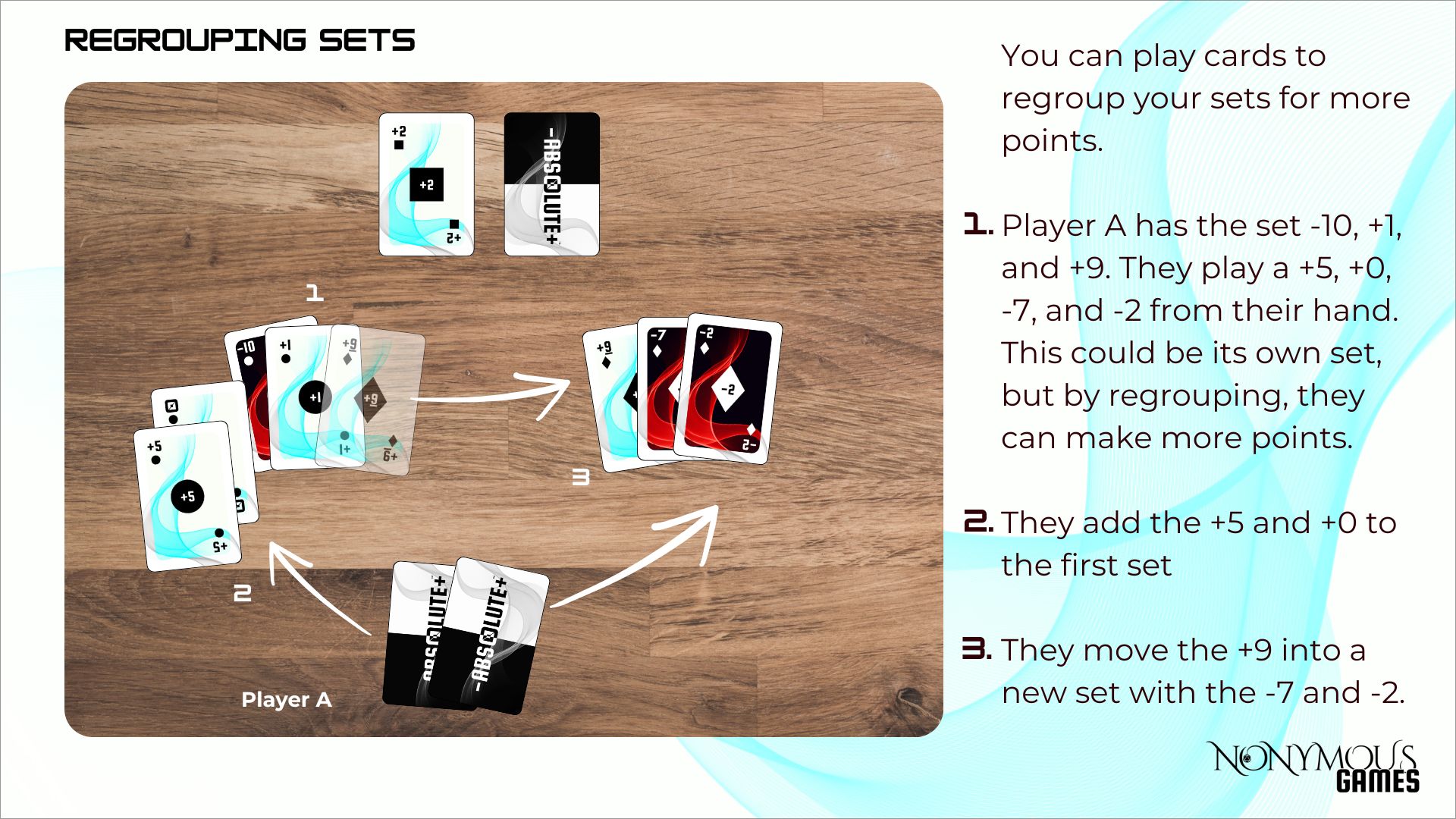
You can play cards to regroup your current set (make new sets from old ones). This allows you to maximize your points and make up for attacks by other players. You must play at least one card to regroup your sets.
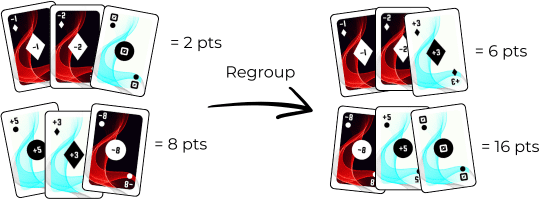
The player starts with the set -1, -2, +0, worth only 2 pts. They play from their hand the -8, +3, and +5 cards as a new set. They realize, "Hey, I can make way more points if I change my sets!" They regroup to a set with -1, -2, +3 (all diamonds), and -8, +5, +0 (all circles), each worth double-points because they have all matching suits (see Scoring).
Scoring
For each set played, we get the following points:
1. Base Points: the largest absolute card number (ignore the sign) is the base points for a set. NOTE: For scoring (including runs and 4 of a kind), zero cards are the number 0, even when representing another number.
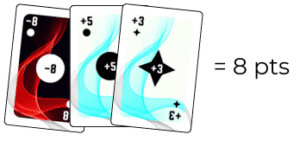
The -8 card is the largest absolute number in this set, so that's the base score: 8 points.
2. Extra Cards: Add 1 point for each card beyond 3 in the set.
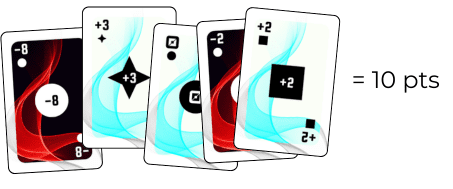
8 base points + 2 extra cards = 10 points.
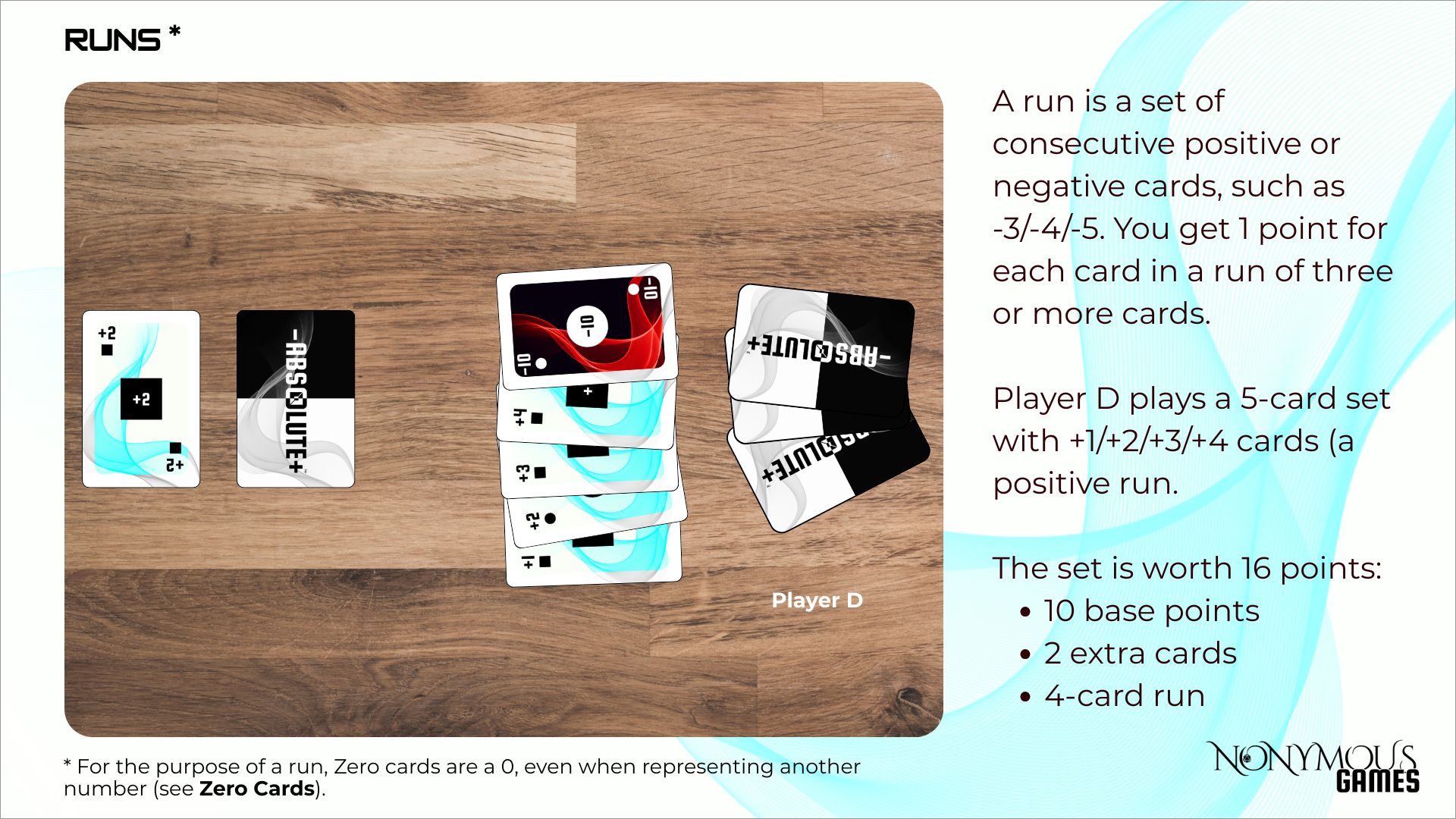
3. Runs: Add 1 point for each card in a positive or negative run (numbers in order: -1/-2/-3...) of three or more cards. NOTE: Zero cards can be in a run as a 0 (such as +0/+1/+2...) even if they are representing another number because we're just looking at the number on the card when scoring, not what it represents.
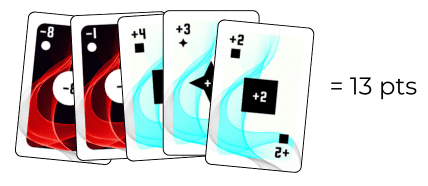
8 base points + 2 extra cards + 3-card run (+2/+3/+4) = 13 points
4. Suits or 4-of-a-Kind: If all the suits in a set match, or a set contains 4 or more of the same numbered card (excluding zero cards), double the total. NOTE: Zeroes representing a number do not count in 4 of a Kind; we're just looking at the number on the card when scoring, not what it represents.
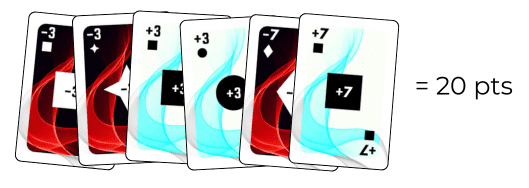
(7 base points + 3 extra cards) x 2 = 20 points [doubled for the four 3's]
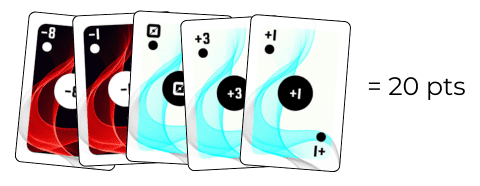
(8 base points + 2 extra cards) x 2 = 20 points [double because they're all circles]
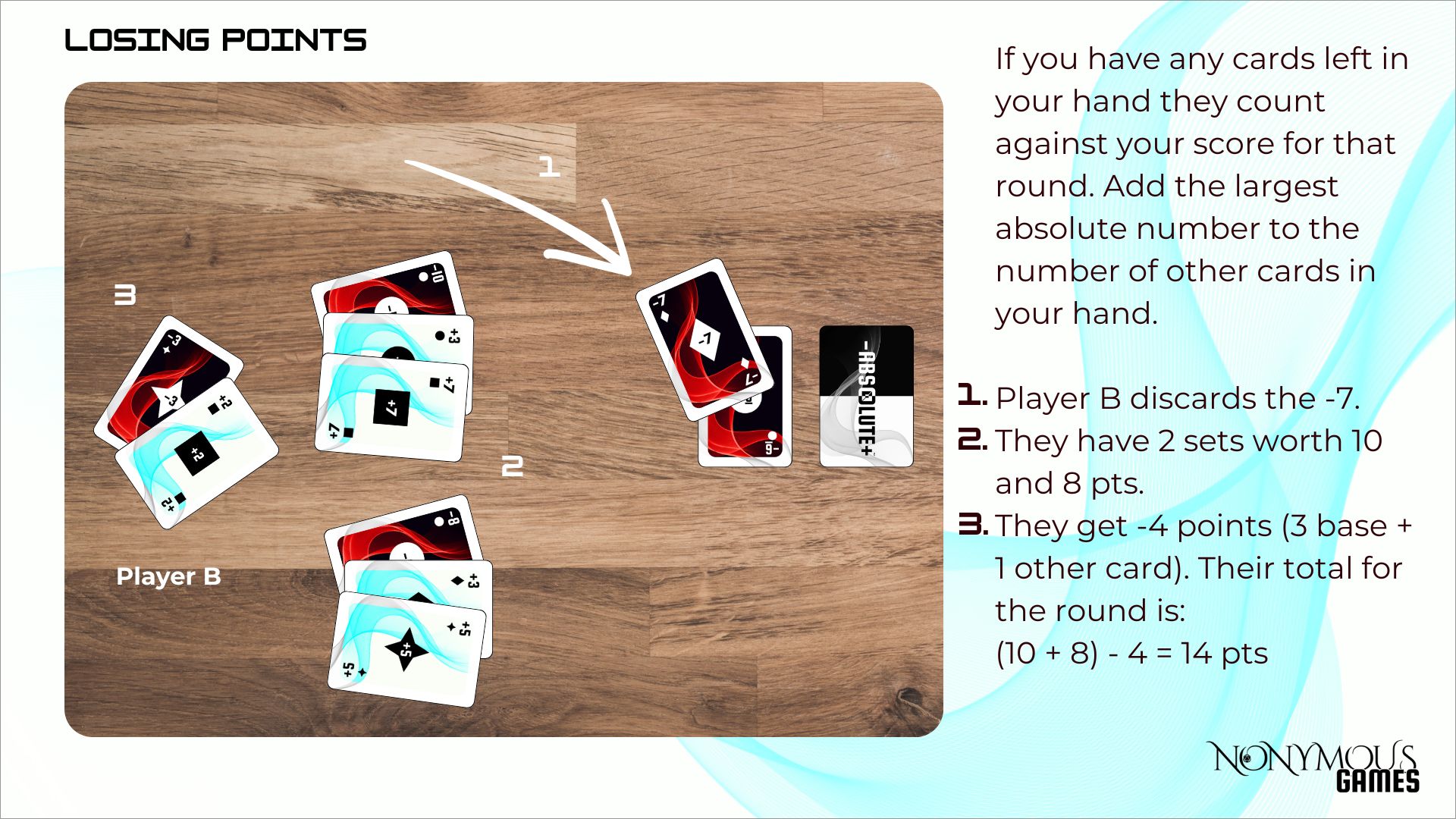
5. Unplayed Cards: You lose points for any cards left in your hand at the end of a round. Take the largest absolute number card plus the number of additional cards.
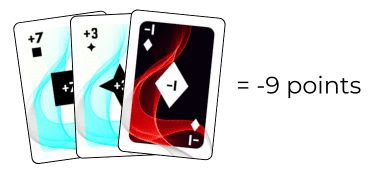
If these cards were left in your hand, you have: 7 base points + 2 other cards = 9 points to subtract
6. Combine all the sets (and negative points from unplayed cards) for your total for that round.
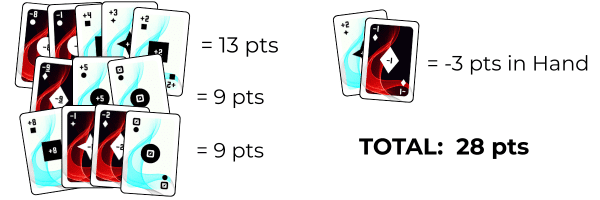
In this example hand, we have 3 sets, but the player didn't go out (had two cards left).
Set 1: 8 base pts + 2 extra cards + 3-card run = 13.
Set 2: 9 base pts = 9.
Set 3: 8 base pts + 1 card = 9 pts.
Cards in hand: 2 base pts + 1 card = -3.
Total for the round: 13 + 9 + 9 = 3 = 28 pts