Dev Journal
Determinism vs. Luck
Providing Stability in a Sea of Ambiguity
Jan 12, 2026
There are figurative (and no doubt literal, if you weighed them) tons of games that utilize luck as a mechanic. Any game with dice. Any game with a shuffled deck of cards or tiles. Anything that is unseen or unknown until it's revealed. All of these things incorporate chance (or what gamers feel as luck) into a game. Some players really enjoy games of chance, and there's a real skill to playing against other players when the entire game comes down to chance.
There's no denying that chance and randomness makes a game feel different every time you play. The opposite of chance is determinism: being able to list out all possible states one after another (think Chess or Checkers). Yes, you may not know which of the available moves a player will make, but you do theoretically know all of the possible moves and all of the moves that can come next, and so on. People who play deterministic games and can think ahead many movements have a strong advantage over those who can only think a couple of movements ahead.
I find that combining these two things - chance and determinism - makes for far more interesting play. Sure you have dice. But can you change the number of dice you have? Can you change the kinds of dice you have? Are there ways of controlling your actions that backstop lower outcomes on your dice? Yes, cards may be drawn at random. But can you manipulate the cards you or others have to make up for that random chance? Can you adjust the availability of particular cards to change the chances of drawing or not drawing them?
There are lots of games that do this. Let's take Dominion, for instance. You have a set number of cards in each game, so you know the ratios and quantities of cards available. As you acquire cards for your deck, you know the chance of having a particular card in your hand, and you can change those changes by adding more of the same card, removing other cards, or using mechanics that can change how you draw/handle cards. Your deck is a randomizer while the choices of your played and purchased cards are your deterministic moves that affect the randomness of shuffling your deck.
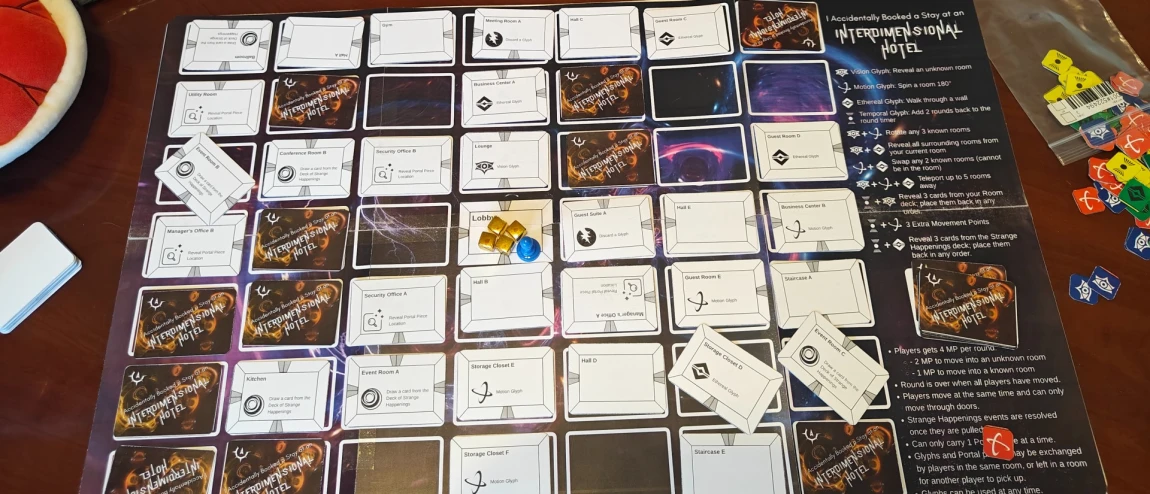
All of this brings me to my latest creation: I Accidentally Booked a Stay at an INTERDIMENSIONAL HOTEL. (Yes, that's a long title; that's the joke, for any of my Isekai-loving friends). We'll call it IH for short. For this game, I wanted to make something where the user's own movements would affect the structure of their board. I also wanted something where even though all the players would be playing cooperatively, they'd be doing so on boards that were all different from one another.
So I envisioned a 7 x 7 grid with a single space in the middle that would be stationary (the hotel Lobby). As you move around the board you reveal rooms of the hotel. However, as each player moves through this interdimensional hotel they can arrive at a completely different room than another player, even if they move through the same door. Everyone would have the same 48 available rooms, but those rooms would be laid out differently for each player. And as each player moves through the hotel, some of their choices can cause rooms to shift, swap, or even be replaced. To add to this, going back through a door you just came from forces the rooms around you to change as well.
The mechanic is taken from procedurally generated levels in video games: these are levels that are generated on-the-fly so that every time you play you get a different layout. The randomness of the room layout means you rarely know where things are, making exploration an important task. But exploration can also change everyone's board, so coordination of exploration for multiple players becomes a big part of time saving. Thse are all the "random chance" parts: where rooms end up, what are the chances you'll locate a particular room, etc.
To add control to the game I added glyphs: these are tokens you acquire as you move through the hotel that allow you to do things such as reveal a room, rotate a room, swap rooms, move through a wall, teleport, and more. These glyphs become tools that you can use to fight against the randomness of the board and the event cards. You can also use your own movement through the hotel to force rooms to change, which also allows some degree of control (like if you get stuck in a loop of rooms, you can go backwards to replace the connected rooms, allowing you a new set of rooms to move through). You can also drop glyphs in a room for other players to pick up when they go through the same room.
It's tricky to balance random chance with strategic choice. Too much chance and you feel like the game just comes down to luck; just revealing room after room without really choosing to do anything. Too little chance and your actions become pre-determined; you find the optimized path to winning the game. So at the moment, I'm working on exactly that: balancing the Strange Happenings deck, the gained glyphs, their powers, and the movement rules to make for a good 1-4 player coordinated game, while still keeping it fresh and challenging on each run through.
Wish me luck! :)