Dev Journal
Take Breath, Make Con-Nections
What we learned as a vendor at our first Gaming Convention
Apr 02, 2026
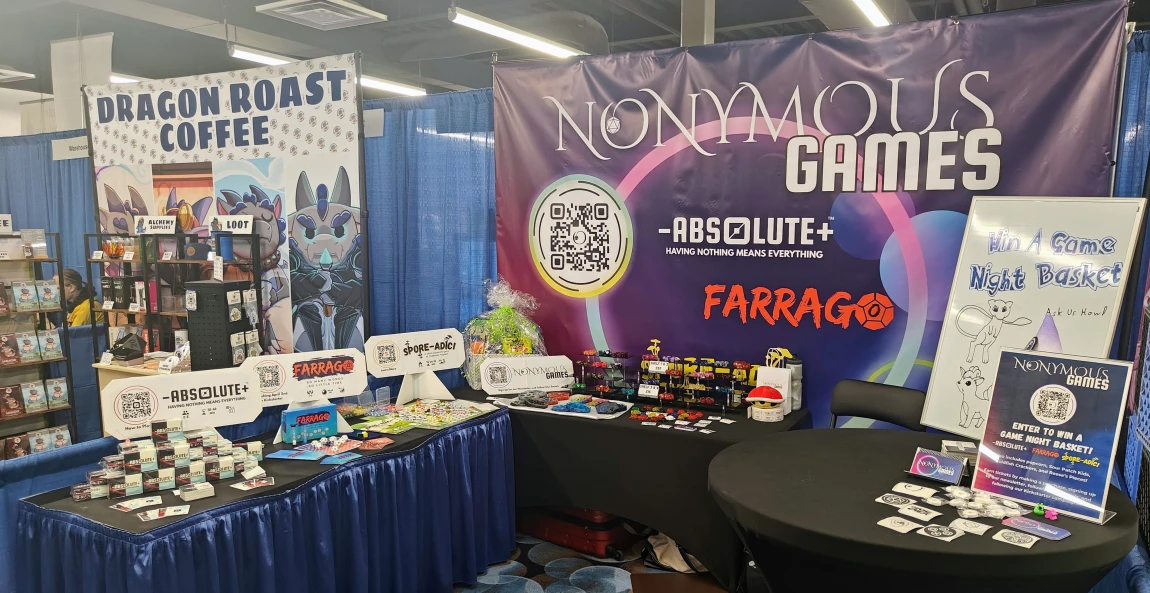
Exhaustion. The absolute first thing we learned.
But beyond that, so much. We attended TokenCon in Midwest City, OK, and while we had been to conventions before as guests, we'd never been as a vendor (at least, not for our own company). We made a list of the various gaming-focused conventions that we could drive to and we chose this one due to it's proximity, recency (it was occuring the soonest), and information we were provided by the Oklahoma Tabletop Design Group (which I'm a part of). We figured it would be a good place to test the waters, learn those things you just can't learn without actually doing, and reviewing the results before we went for broke on some massive con half-way across the country.
In essence, though TokenCon is a very real and great convention, it was a company-level version of a playtest:
- Do the players (con guests) like our design? [Our booth elements, layout, visual presentation]
- Do they like the compnents? [Our games, trinkets to sell, heck, US! lol]
- Is the board layout conducisve to interaction? [Does the booth layout allow us to engage with the guests quickly and in volume]
- How is the level of interaction in the game? [Do we know how best to present our games and ourselves to the guests?]
- Is this a game the players enjoyed? [Did a guest make a purchase? Follow our socials? Enjoy our convesations/interactions?]
Like any playtest, some things went smoothly, while others flowed like chunky peanut butter. Below are some of the takeaways we found over our four days.
Connections
While I'd virtually met several of the game designers present on Discord, it was good to meet people in person, see their games, and how they presented themselves and their company to the public. More, it was nice to support each other with people buying games from one another, and local game stores/cafes speaking with designers to get their indie games into stores and in front of the public.
Meeting people from other businesses was very interesting: they all had different reasons for being at conventions, different goals, and different experiences they shared. The majority of people were very helpful with information about how to make the best out of conventions, what goals to focus on, and what little tricks help them survive the daily chaos.
Preparation
While it's rare everything goes to plan (I literally forgot ONE bag that had all our linens and such in it, which we had to retreive), the full booth setup we did in the garage before we went was super helpful. 10x10 sounds like a large space, and might be twice the size of a NY apartment, but when you're trying to showcase multiple games, do demos, talk to guests, and make the whole thing look inviting... that space shrinks mighty fast.
We spent multiple days setting up everything we wanted to have in the booth during our runthrough. And I mean EVERYTHING. We even laid out every single set of dice we were bringing with us, all the various stickers we were giving away, you name it. If it was in the booth at the show, it was set up in the booth in our garage. And while not everything was perfect, it was great to be able to have a blueprint of where everything would go once we arrived, the order to set things up in, and of course a big checklist of everything to bring and set up (of which, again, I missed a single item). :p
Endurance
You're in a con for the long haul. If you've been to one as a guest and have gotten tired walking around, rest assured: standing around is much more tiring. Though we had tall stools which helped, and a small cushioned mat to stand on, it's not just the literal standing. It's the constant din, the interior lighting, the pressure of people looking and judging you and your booth and your games.
Interactions don't come at a steady clip, but in waves: you'll be sitting at your booth doing your best to not look bored, and then suddenly you'll have one visitor, then three, then a dozen. You need to be able to focus on describing a game while being open and inviting to others walking by. You need to be friendly and evaluate someone's interest so that you don't lock in and bore them with the wrong game or details. It's a lot of quick, mental and personality gymnastics. And if you're a bit of an introvert like me, it will most assuredly wear you out.
If you can, have at least two people in the booth; three if you are going to be there for three or more days. This way you can work in shifts. We only had my wife and I, so we had to be careful not to take too long of breaks, otherwise we could be leaving the booth understaffed for the big rushes of people.
Demos
And speaking of leaving the booth understaffed, doing dedicated demos of your games at cons is a fantastic way for people to learn about your upcoming releases, and to playtest games (though with some caveats). The problem is that with only two people, one has to run the booth while one has to run the demos, leaving the booth with only a single person. While okay for short stints, this can be tricky over an hour or two. Some booth experts - like our awesome neighbor from Dragonroast Coffee that does dozens of conventions a year! - were able to handle it like a pro. But as a beginner, it was a little harder on us.
If you want to do game demos, I'd definitely strategize the timing so that you can make sure your booth runner isn't overwhelmed, and that you're all taking breaks and eating; do NOT let yourself get hangry! Snacks are a plus.
Now, about those caveats:
- Doing a blind playtest at a gaming con would not be my recommendation unless you have a supremely easy-to-learn game. It takes longer for people - especially a group of strangers - to learn a game just from the instructions and zero explanation. That's just a given.
- Having a method of teaching your game will only get you so far - be flexible in how you describe your game and what those particular players need to understand in order to get playing quickly. While I've done hundreds of open playtests of our games, the way they're taught changes when you're in a large convention space with a time constraint and all the other pressures that a convention brings, including the stress of doing this for days.
- At a con, it will be LOUD. So doing a guided playtest means speaking clearly over the din, and hoping you can demo any complex items quickly.
- While most people at a gaming con will focus on the games, some just... can't. What I mean is the group of people might not end up being comfortable with one another, which ultimately can color their perception of the gameplay experience. Watch for signs of social rather than gaming issues and do your best to steer the focus back to the game.
Goal Setting
Since this was our first convention, we didn't set any hard-numbered goals. Sure, it would be nice to do things like recoop your booth costs, or all the con costs (food, hotel, gas, etc.), but we strictly avoided doing that because we literally had zero clue how any of this would go. Setting a goal like "We want to increase our followers by X" or "We want to may $Y" is unreasonable at your first convention, and just puts pressure on you to try and achieve something that you have no clue going in if it'll be possible.
So instead, we set more amorphous goals:
- Increase our subscriber base: we wanted to grow our email list, social follows, and Kickstarter follows.
- Raise interest in our games and our brand.
- Sell Absolute and our resin works (dice, dice cases, and turtles)
- Make connections
To that end, we hit all four goals. We more than double all of our subscribers across all mediums. We spoke to store owners and cafes and fellow designers and gamers, and raised awareness of our games and our company goals. In the end we sold enough copies of Absolute and our resin works to pay for the booth and about half or our other one-time expenses. And we made some awesome connections, even to the level I'd comfortably call friends, in just a four-day period.
No, we didn't set static goals. But now that we have actual metrics, we can have a better idea how to judge our performance at future conventions, and after a few more, then I think we can start setting target goals. But I'd definitely recommend not setting hard numbers and putting more pressure on yourself than necessary. Enjoy the learning process and have fun!