Dev Journal
Research and Authenticity
The Feeling of Real Comes From Research
Feb 10, 2026
It (relatively) easy to base a game off of a concept. Take an idea, apply a goal, determine if it's cooperative or competitive, add mechanics to achieve or deter from that goal, and keep building. To that end, you can take most things and bring them to the table as a game. But does it feel... real? Authentic? That wholely depends on the effort you put into your research.
I wanted to make a board game that would be akin to a dance competition. Like Just Dance from the Wii: little icons showing the different dance moves you had to hit just right to score big. As I thought on it more, I started to picture the dance battles in Tokyo, Seoul, the Bronx. Steppin' up and throwin' down moves and tricks in flow with the music. The more I thought, the more I moved from the "Just Dance" concept to the break dance battles. But know what? I didn't know very much about them.
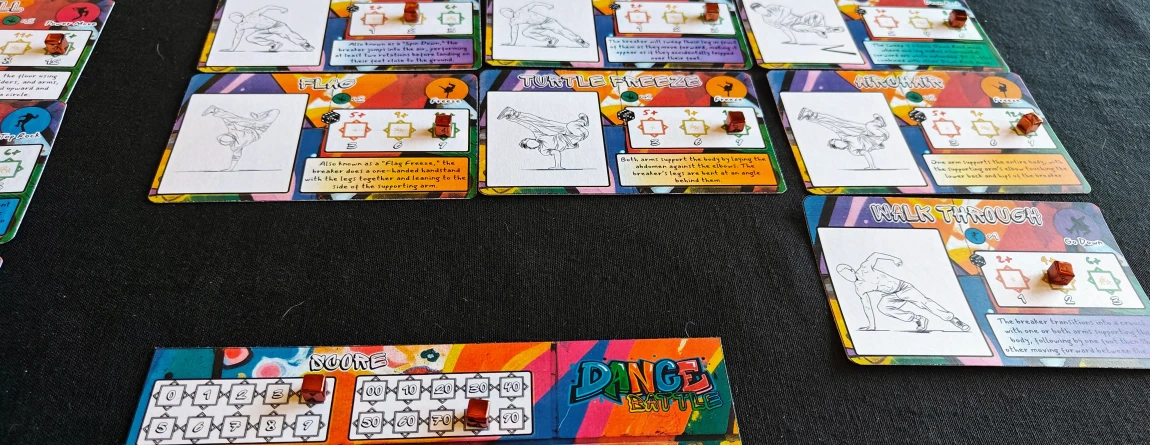
The game would center around choosing a dance move card to do and deciding how much stamina to spend on that move. The more you spend, the more dice you can roll to try and get a better score on that move. But spend too much, and you won't be able to make it through the whole song. So it would combine the tactics of choosing which kinds of dance move cards to try, and how much stamina to save or spend. Dice and cards; classic combo. All that was pretty straightforward to come up with.
As I started to think about the card designs, I thought about the beautiful graffiti art in Brooklyn. I could see it on the walls: colorful, vibrant. An eclectic backdrop in front of which will be the dance move artwork. And as I started to design the cards, not only did I realize that I'll need a real artist (and not my amateur self), but every move has a name. An origin. I was using placeholder stock graphics and I could see that there was a complete story that made each one such an iconic silhouette.
I had to know more.
I started to read about break dance battles: their origins, their moves. The dancers (b-girls and b-boys). I learned about Top rock, Go Downs, Down Rock, Freezes, Power Moves, and the amazing history that comes with all of it. I didn't want to just have images of these moves; I wanted them to make sense. I wanted a breaker to look at the cards and say, "Naw, that's the not the right lead up for that move" or "Yes, that combo is tight." Because it's not enough just to build a game around an idea, especially one that has so much history. The authenticity can bring so much to the game. The history and details can bring so much to the players, immersing them not only in a game but in a world they otherwise might not experience.
After a couple weeks of reading and watching videos, I selected 38 (!!!) moves to create the cards from, in five different categories. Yeah, it's gonna require a lot of good artwork, but there are a lot of good artists out there. I can't wait to find one to bring this vision to life, and make it feel like we're watching an amazing show of skill, rhythm, power, and flow. All laid out on a table.
It's only too easy to take the simple route; bite on a culture without understanding what it is you're taking from it. I encourage my fellow designers to always look beyond the game, and not just take inspiration from something but dig into that inspiration. Let it fill you up and guide your game. You'll be amazed with how far it'll take you if you stay true to it.